Bulk Server CPU and Processor Supplier
We supply server and desktop processors in volume, tested and identified by exact part number. Stock covers multiple generations of server silicon alongside desktop and workstation processors. Because processor pricing moves quickly with generation and core count, we quote against the specific part number rather than a general description.
Specifications
What we hold in CPUs.
- Server platforms
- Multi generation server processors
- Client platforms
- Desktop and workstation processors
- Packaging
- Tray and boxed
- Core counts
- 4 core through 64 core and above
- Conditions
- New, refurbished, tested pulls
- Identification
- Quoted by exact part number
Typical stock
Commonly available.
- Server processors pulled from decommissioned nodes
- Matched processor pairs for dual socket boards
- Desktop and workstation processors in volume
- Tray processors in bulk quantities
- Mixed generation lots with full manifests
Looking for a specific part number?
Send the part number and quantity. We quote against live stock, and if we cannot get it we will say so rather than substitute something else.
Clearing CPUs rather than buying? Sell your surplus CPUs to GTR Supply. That page sets out what we take, what your list needs to carry for CPUs, and what moves the number up or down.
In circulation
CPUs makes, models and part numbers.
Almost everything traded in this category is a socketed server processor pulled from a decommissioned node, and the two socket lines dominate the volume: Xeon E5-2600 v3 and v4, then Xeon Scalable across four socket generations, then EPYC on SP3 and SP5. The families below are split on socket boundaries, because the socket is the only line that actually stops a part working and because a mixed fleet is several lots rather than one. Two things cut across all of them and belong on the page as well.
None of this is a stock list
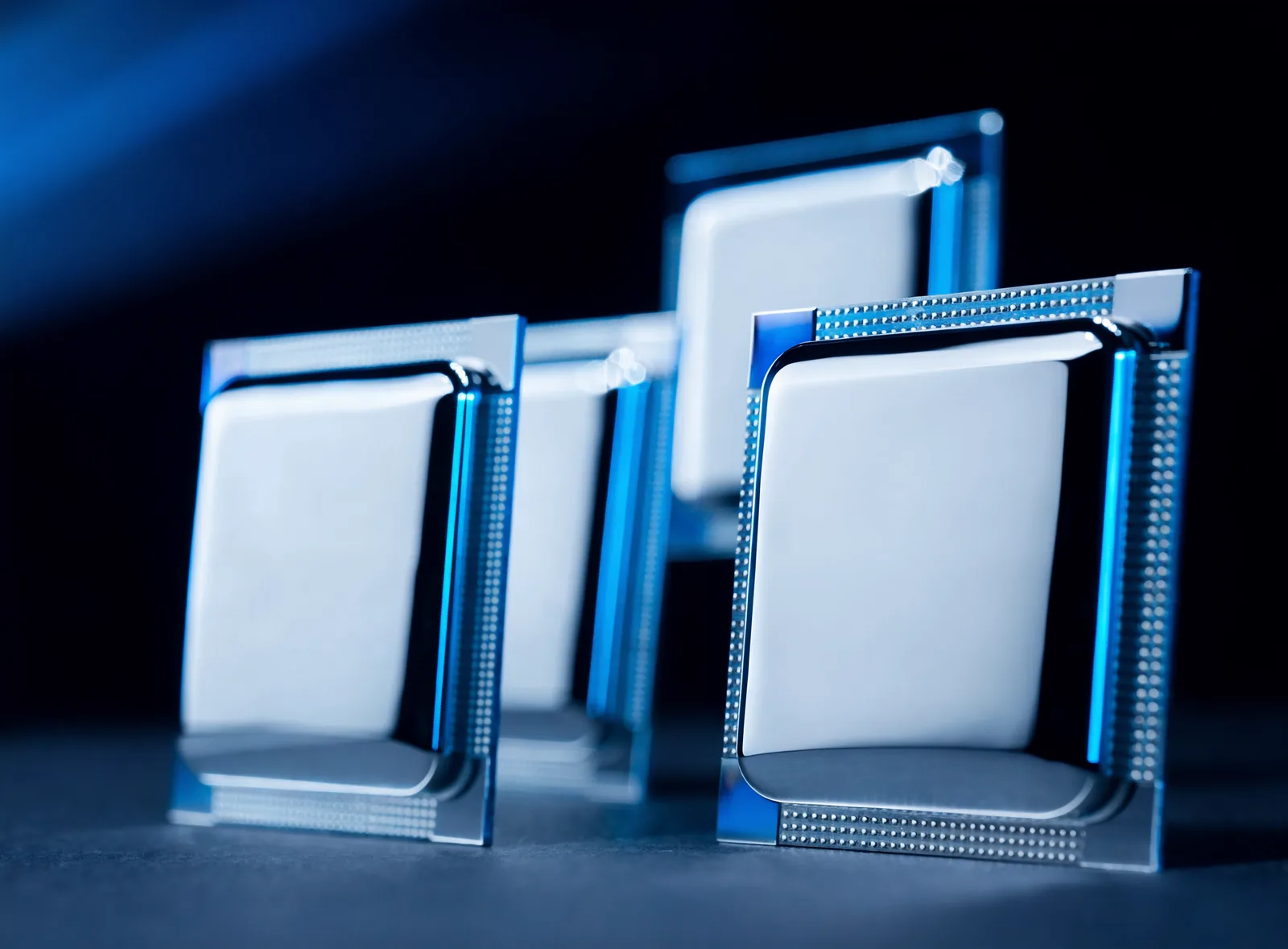
The families below are what circulates in this category on the secondary market, listed so you can work out what you are holding or what you need. None of it is a stock listing and nothing here says GTR Supply holds a particular part. The photographs illustrate the form factor and are not photographs of any named product. Send the part number and the quantity you need and we will tell you where we stand.

Intel Xeon E5-2600 v3 and v4
Intel
The two socket workhorse of the mid 2010s, the silicon inside 13G Dell and Gen9 HPE nodes. A v4 part drops into a v3 board once the firmware supports it. Decommissions still release it in volume, and it suits rebuilds and spares for estates not yet moving.
- How to spot it
- Reads E5-2600 with a v3 or v4 suffix, and carries a five character spec code beginning SR on the lid. Square LGA2011-3 package, gold pads underneath, no carrier frame.

Intel Xeon Scalable, first and second generation
Intel
Skylake and Cascade Lake, the 14G Dell and Gen10 HPE era, and one of the largest pools of two socket silicon in circulation. The R refresh parts such as a 6248R are second generation too. Both generations share one socket, so they cross freely with firmware support.
- How to spot it
- A tier word plus four digits, where the second digit is the generation: 3106 or 6148 is first generation, 4214 or 6248 is second. Long rectangular LGA3647 package.

Intel Xeon Scalable, third generation
Intel
Ice Lake, the 15G Dell and Gen10 Plus HPE generation, now arriving as those fleets are refreshed. A socket and memory platform of its own, so nothing crosses in either direction. The four socket H parts of the same generation sit on a separate platform again.
- How to spot it
- Four digits with 3 in the second position, so 4310, 5318, 6338 or 8380. A larger, squarer LGA4189 package that fits neither the socket before it nor the one after.

Intel Xeon Scalable fourth and fifth generation, and Xeon 6
Intel
Sapphire Rapids and Emerald Rapids on DDR5, the 16G Dell and Gen11 HPE generation. Secondary volume is thinner than the older lines and comes out of early cloud and AI refreshes rather than end of life fleets. Xeon 6 moved again to two new sockets.
- How to spot it
- Second digit 4 or 5, as in 5416S, 6430 or 8480+, on the very large LGA4677 package, usually still in its plastic carrier. Xeon 6 dropped the tier words for 6500P and 6700P numbering.

AMD EPYC 7001, 7002 and 7003
AMD
Naples, Rome and Milan, the three generations sharing the SP3 socket. Rome and Milan are what mostly circulates, out of the same refreshes releasing Cascade Lake. Milan-X adds stacked cache. Firmware rather than the socket decides which board will take which part.
- How to spot it
- A four digit model beginning 7 and ending 1, 2 or 3, with an ordering part number of 100 followed by nine digits on the lid. Large SP3 package in a carrier frame.

AMD EPYC 9004, 9005 and the 8004 line
AMD
Genoa, Bergamo, Genoa-X and Turin, the current two socket AMD line on DDR5, with the dense core parts in the same family. Supply into the secondary market is early and comes from cloud and AI buildouts rather than from fleets reaching end of life.
- How to spot it
- A model beginning 9 on the very large SP5 socket, or beginning 8 on the smaller single socket SP6. Both are a hard physical wall against anything built for SP3.

Hyperscale and OEM specific SKUs
Intel and AMD
Parts made for one hyperscaler or server vendor and never sold through the general channel, so they reach the market almost only through decommissions. Core counts usually match a catalogue part. Some AMD processors fuse to the first platform they boot in, which is worth recording before one is pulled.
- How to spot it
- Models built for one cloud or server vendor: Intel parts ending C, CL or M such as 8272CL, and AMD 7B, 7C, 7J and 7T parts such as 7B13. Some AMD ordering numbers carry a vendor suffix.

Intel Xeon E and Xeon E3-1200
Intel
The entry server line, found in towers and single socket rack machines and in a great many small business decommissions. Core counts are low and the socket changes almost every generation, so a mixed lot is worth grouping by socket rather than by family name.
- How to spot it
- Single socket entry parts. E3-1200 v3 and v4 on LGA1150, v5 and v6 on LGA1151, then E-2100 and E-2200 on LGA1151, E-2300 on LGA1200 and E-2400 on LGA1700.

Intel Xeon W and AMD Threadripper PRO
Intel and AMD
Pulled from Precision, Z and ThinkStation towers on a fleet refresh, so they surface in consistent batches rather than singly. ECC capable with four or eight memory channels, which is what separates them from desktop silicon of the same era.
- How to spot it
- Workstation silicon. Xeon W-2100 and W-2200 on LGA2066, W-3200 on LGA3647, and w5 or w7 branded 2400 and 3400 parts on LGA4677. Threadripper PRO uses sWRX8, then sTR5.

Desktop processors from fleet refreshes
Intel and AMD
Corporate desktop refreshes release these in consistent configurations, mostly out of small form factor and micro machines. Sockets changed several times across the run, so a lot is far easier to place when it is listed by model number rather than counted as a pile.
- How to spot it
- Small square packages with alignment notches on two edges. Intel Core i5, i7 and i9 with four or five digit model numbers, and AMD Ryzen and Ryzen PRO. Boxed parts carry a retail cooler.
Trademarks
All product and company names are the trademarks of their respective owners. GTR Supply is an independent trader with no affiliation to, authorization from, or endorsement by any manufacturer named on this page.
Request a quote
Get pricing on CPUs.
Tell us the specification and volume you need. Most requests are quoted the same business day, against a full manifest so you can price accurately.
Common questions
CPUs questions, answered.
Do you quote by part number?
Always. Processor pricing varies enormously by generation, core count, clock speed and stepping, and a general description is not enough to price accurately or honestly.
The gap is wider than people expect. Two processors from the same family and socket, bought in the same condition, can differ several times over in value on core count alone. Quoting from a description such as a mid range server processor would mean either overcharging you or committing to a number we cannot stand behind once we see what you actually want.
The part number settles all of it at once, including details that are easy to overlook, such as whether a part is a low power variant or an OEM specific version that will not run outside its original platform.
Send the part number and the quantity and you will normally have pricing back the same day.
Can you supply matched pairs for dual socket servers?
Yes. Where a deployment requires it we can supply matched pairs drawn from the same batch, and we do this regularly for dual socket builds.
Flag it at quote stage rather than afterwards. Dual socket boards expect both processors to be the same model and stepping, and mixing across steppings can produce instability that is difficult to diagnose later, because the machine will often boot and run normally before it misbehaves under load. Pulling genuinely matched parts also takes more effort than taking two of the same model number from separate lots, so it needs to be priced in from the start rather than bolted on at the end.
If you are building a cluster rather than a single machine, tell us the node count as well. Matching across an entire batch of nodes is a different exercise from matching one pair.
Are processors tested?
Yes. Processors are tested before dispatch and the pins or contact pads are inspected on every unit.
Physical inspection matters as much as the electrical testing here, because the most common fault in used server silicon is mechanical rather than electrical. On LGA parts the pins sit in the socket rather than on the chip, so the risk is bent or contaminated contact pads on the processor itself. On PGA parts the pins are on the processor and a single bent pin can stop the machine posting entirely. Neither shows up in a specification sheet, and neither is visible once a part is sitting in a tray with fifty others.
Every unit is therefore inspected individually rather than sampled. Where a processor has been pulled from a working node, that is the strongest evidence available that it functions, and we record it against the lot.
Do you handle very large processor quantities?
Yes. Large processor lots are normal for us, because server decommissions release them in volume rather than in ones and twos.
Send the full requirement rather than a trial quantity. Volume changes the answer materially in this category, more than in most others, because it changes which lots we can commit to one buyer. Processors are frequently held as part of a whole node or a whole rack rather than as loose parts, so a requirement large enough to take an entire decommission off the shelf opens options that a small request simply does not.
The practical effect is that a small trial order can quote at a worse unit price than the real order you are working towards, which then makes us look uncompetitive on the thing you actually wanted. Tell us the real number, even if you intend to start smaller.
Guides
Buying CPUs by the lot is a different exercise from buying one unit at a time. These cover the questions that come up before a price is worth discussing.
Brands
Nobody buys or sells CPUs well without knowing exactly which generation and configuration is in front of them, and the number that tells you sits somewhere different on every manufacturer's hardware. These pages show where to look and how to read what you find. They are identification help rather than stock lists, so send the part number and the quantity and we will tell you where we stand.
Dell PowerEdge Servers: How to Identify What You Have
Reading a PowerEdge model number
HPE ProLiant Servers: How to Identify What You Have
The product number, and why it says more than the model name
Supermicro Servers: How to Identify What You Have
Why there is no service tag, and what to photograph instead
Server Processors: Identifying Intel Xeon and AMD EPYC
Intel: the spec code on the heat spreader
Server Memory Brands: Samsung, SK hynix and Micron
Three fabs, many labels, and where Kingston and Crucial sit
Every brand GTR Supply buys and sells, grouped by category, with the identification detail for each one.
Other categories
GPUs
Data center accelerators and workstation graphics cards in volume.
Servers
Rackmount servers, nodes and configured systems, ready to deploy.
Storage Arrays
SAN and NAS arrays, JBOD enclosures and disk shelves, populated or empty.
Networking
Switches, NICs, transceivers and rack infrastructure from the leading brands.
Let's talk hardware.
Tell us what you are buying or selling. We will get you a number fast.
Prefer WhatsApp? Message us on (945) 397-7765